Human-in-the-Loop Solutions for AI/ML

NextWealth’s Human-in-the-Loop AI/ML Solutions improve model outcomes by validating predictions, correcting edge cases, and refining training data through expert human oversight at every critical stage.

In a world racing toward full automation, there’s one truth the AI industry keeps relearning: models trained without strong human oversight underperform, drift, and fail in ways that matter. From labelling the nuances in a medical image to catching a deepfake that an automated classifier missed, human intelligence remains the decisive variable in building AI that is accurate, fair, and production-ready.

At NextWealth, Human-in-the-Loop (HITL) is not a feature we offer , it is the operating model we are built around. Our HITL services span the full AI lifecycle: training data annotation, inference-time validation, post-deployment feedback loops, and ongoing model monitoring for drift and performance degradation. Clients working with our HITL pipelines have reported annotation accuracy improvements of 20–35% over fully automated baselines, reduction in model error rates by up to 40% within two retraining cycles, and faster time-to-production for ML models by replacing slow, inconsistent in-house labelling with structured, SLA-backed annotation workflows.
What is Human-in-the-Loop In AI Workflows? (HITL)?

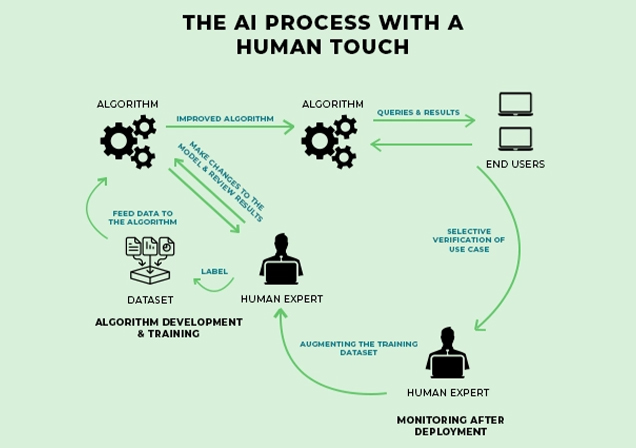
Human-in-the-Loop is a process where human intelligence is integrated into AI model training, evaluation, and refinement creating a feedback loop in which humans annotate data, validate predictions, correct errors, and continuously improve model performance. HITL ensures that AI systems develop accuracy, fairness, and contextual understanding: qualities that purely automated pipelines consistently struggle to replicate.
HITL is not a workaround for weak AI….it is the methodology that the world’s most reliable AI systems are built on. From RLHF-trained large language models to safety-critical medical imaging tools, the models that perform best in production are the ones with the most rigorous human feedback built into their development cycle.

Types of Human-in-the-Loop

Training-Time HITL

In this approach, humans are involved in labeling datasets and setting the right parameters before the AI model is trained. Their role is critical in curating balanced, bias-free data that enables models to generalize better.
Training-Time HITL

Inference-Time HITL

Here, humans step in during real-time decision-making. They validate or override AI outputs in high-stakes use cases like medical diagnps 85is, content moderation, or autonomous driving to avoid false positives or critical errors.
Inference-Time HITL

Feedback-Loop HITL

After deployment, models continue to learn. Humans review outcomes and provide feedback, helping systems evolve with time. This loop is essential for industries where data patterns constantly shift, like e-commerce or financial fraud detection.
Feedback-Loop HITL

Blind Spot Detection

Blind Spot Detection systems monitor areas alongside and just behind the vehicle that drivers can’t easily see. Using side-mounted radar sensors and rear-facing cameras, these systems alert drivers to approaching vehicles in adjacent lanes. Annotating training data for such systems includes lane markings, vehicle proximity, sensor zones, and occlusion scenarios. With real-time warnings, Blind Spot Detection enhances safety during lane changes and merges. It’s especially critical for larger vehicles and highway driving, and relies on high-quality data labeling for automotive safety applications.
Blind Spot Detection

Driver Monitoring Systems (DMS)

Driver Monitoring Systems use in-cabin cameras and AI to assess driver attentiveness, fatigue, and distraction. These systems track head position, eye movement, blink rate, and gaze direction. Training such models requires detailed annotation of facial landmarks, expressions, and micro-behaviors under varying lighting conditions. DMS plays a pivotal role in reducing accidents due to human error and is mandated in many global safety standards. At NextWealth, we specialize in data annotation for automotive DMS, ensuring models perform accurately across geographies and driver demographics.
Driver Monitoring Systems (DMS)

Automated Parking Assistance

Automated Parking Assistance helps drivers park by detecting open spaces and maneuvering the vehicle using sensors and steering algorithms. It involves obstacle detection, path planning, and real-time motion control. Annotation tasks include segmenting parking slots, identifying curbs, pedestrians, and dynamic objects. The solution uses a combination of camera and ultrasonic sensor data. High-quality annotations ensure parking systems operate safely in tight or complex environments, improving both convenience and vehicle safety. It’s an essential module in the progression toward fully autonomous vehicles.
Automated Parking Assistance

Gesture Recognition

Gesture Recognition allows drivers or passengers to interact with the vehicle’s systems through hand or head movements, enabling touch-free controls for infotainment, AC, or calls. This system relies on in-cabin cameras and AI trained with annotated gesture datasets—including hand position, motion path, and intent classification. It enhances user experience and safety by reducing distractions. As part of next-gen advanced driver assistance systems, this feature depends on precise human-in-the-loop data annotation to recognize varied gestures across cultures, lighting, and driver postures.
Gesture Recognition

Types of Human-in-the-Loop

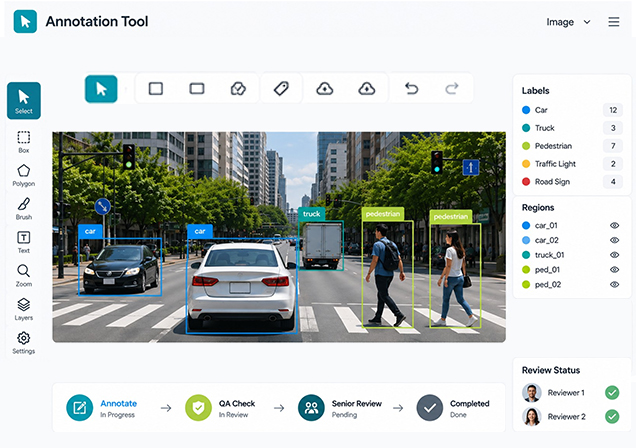
At the training stage, humans define the ground truth. Annotators label datasets, set classification parameters, resolve ambiguous cases, and curate balanced, bias-aware training data that enables models to generalise reliably across real-world conditions. This is where annotation tooling matters most. NextWealth’s annotators work across all major platforms including Labelbox, Scale AI, CVAT, Label Studio, and MD.ai for medical imaging, as well as client-proprietary tools. The right tooling, combined with trained human judgment, is what separates annotation that trains good models from annotation that trains brittle ones.
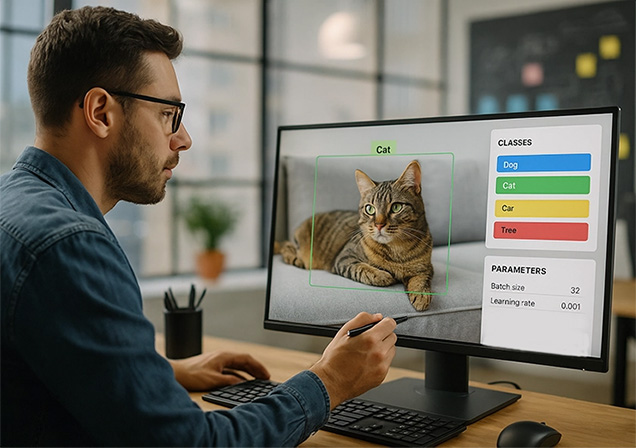
At the inference stage, humans step in during real-time or near-real-time decision-making validating or overriding AI outputs before they result in consequential actions. In high-stakes domains like medical diagnosis, content moderation, financial fraud review, and autonomous system oversight, inference-time HITL prevents false positives and critical errors from reaching end users. Our teams operate inference-time review queues with defined escalation paths and turnaround SLAs ensuring human oversight is fast enough to be operationally viable, not just theoretically sound.

After deployment, models encounter data they were never trained on. Feedback-loop HITL puts humans back in the cycle reviewing model outputs, flagging errors, and returning corrected labels to retrain the model. This is the mechanism behind active learning: the model routes its lowest-confidence predictions to human reviewers, concentrating annotation effort where it has the greatest impact on model improvement. NextWealth supports active learning integration natively, receiving model-flagged samples and returning high-quality annotations on defined SLA timelines.
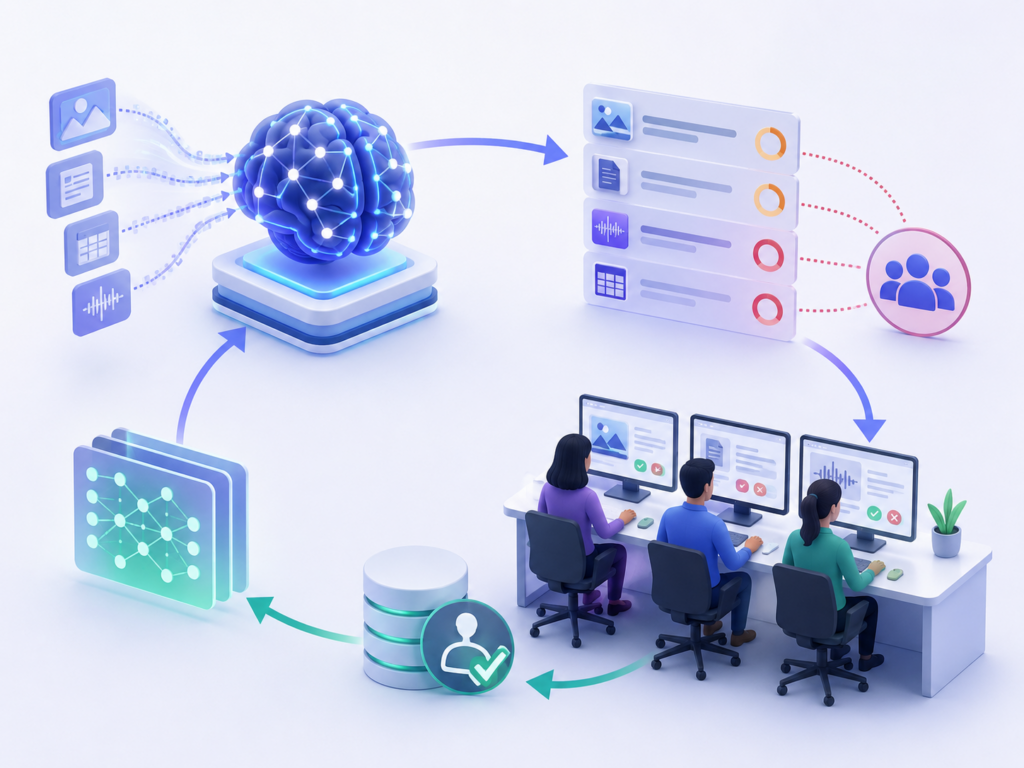
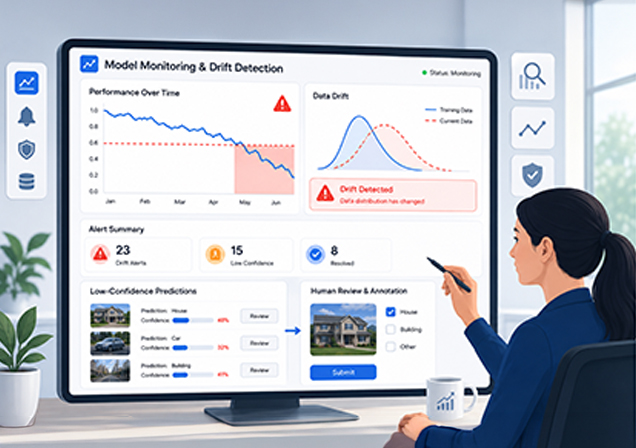
After deployment, AI models require monitoring as real-world data, user behaviour, and operating conditions change. NextWealth’s human reviewers examine incoming production samples to detect early data drift and distribution shifts that automated tools may miss. Teams conduct regular label-consistency audits by re-annotating benchmark datasets and comparing outputs with ground truth. Structured reviews of edge cases and high-risk categories help identify performance regressions, recurring errors, and emerging failure modes. When drift is confirmed, corrective datasets are rapidly annotated and curated for retraining, helping organisations maintain model accuracy, reliability, and consistency across fast-changing domains such as finance, healthcare, e-commerce, and content moderation.

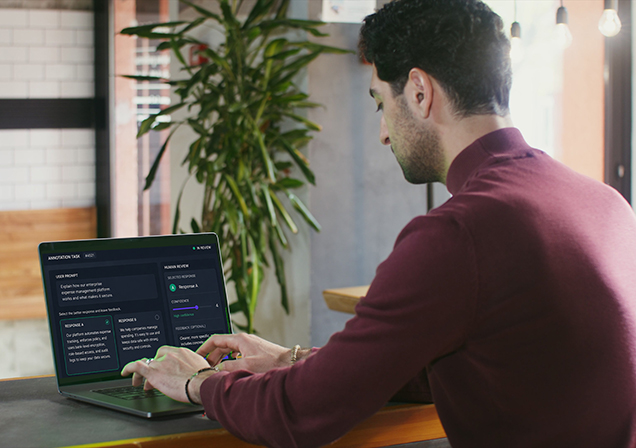
Reinforcement Learning from Human Feedback (RLHF) is the training methodology behind the most capable AI models in production today. It requires human annotators to rank, compare, and evaluate model-generated outputs directly shaping model behaviour toward human-preferred responses. NextWealth supports RLHF annotation for both language and vision models: response ranking, pairwise comparison, instruction-following evaluation, quality scoring, and red-teaming annotation. Our RLHF workflows have helped clients achieve measurable improvements in model alignment within two to three retraining cycles.
Annotation Tooling in the HITL Workflow

The quality of HITL output is inseparable from the quality of the tooling it runs on. NextWealth is platform-agnostic where we work with your existing annotation infrastructure or advise on the right platform for your use case.

Use Case Platforms We Support
General image & video annotation Labelbox, Scale AI, CVAT, Label Studio, Roboflow
LiDAR & 3D point cloud Supervisely, Scale Lidar, Cogniteam
Medical imaging MD.ai, ITK-SNAP, 3D Slicer
Text & NLP annotation Prodigy, Doccano, Label Studio
RLHF & model feedback Custom pipelines, proprietary client platforms
Client-proprietary tools Full integration via API or custom workflow

Use Cases of HITL Across Industries

Healthcare

Human annotators label radiology scans, pathology slides, MRI sequences, and CT imagery providing the ground truth that diagnostic AI models learn from. Beyond training-time annotation, HITL inference-time review ensures that AI-assisted diagnoses are validated by trained reviewers before influencing clinical decisions. Our drift monitoring support also helps healthcare AI teams detect when model performance degrades on new patient populations or imaging equipment variants.


E-Commerce & Retail

HITL powers product cataloguing, visual search, recommendation engines, and UGC content moderation at the scale e-commerce platforms demand. Human reviewers tag and categorise millions of SKUs, validate automated attribute extraction, and feed corrected labels back into active learning loops continuously improving catalogue accuracy without proportional growth in annotation spend. Clients have seen catalogue tagging accuracy improve by over 30% within three active learning cycles using our HITL pipeline.


Autonomous Vehicles
Annotators label video frames, LiDAR point clouds, and sensor-fused data for pedestrian detection, traffic sign recognition, lane boundary mapping, and in-cabin monitoring. HITL is non-negotiable in this domain edge cases missed during training become safety failures in deployment. Our feedback-loop and drift monitoring services also support AV teams in identifying when production data begins to diverge from training distributions, triggering targeted retraining before performance degrades.

Agriculture

Image annotation for drone and satellite footage supports crop health monitoring, pest and disease detection, yield estimation, and land use classification. Human annotators handle the contextual judgment that automated classifiers miss distinguishing early-stage crop stress from normal variation, or identifying uncommon pest patterns not well-represented in training data.

Finance

HITL annotation supports fraud detection pattern labelling, KYC document verification, AML transaction review, and regulatory compliance data curation. In financial services, the cost of a false negative a missed fraud case or a failed compliance check far exceeds the cost of human review. Our inference-time HITL queues are structured to handle time-sensitive financial review workflows with defined escalation paths and audit trails.

Trust & Safety
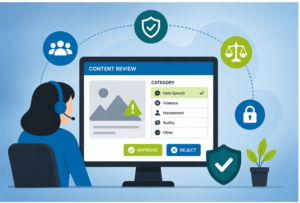
Content moderation, deepfake detection, CSAM identification, and harmful content classification all depend on human judgment that automated systems cannot replicate reliably. HITL is the operational core of effective Trust & Safety programmes not a supplement to automation, but the layer that makes automation safe to deploy. Our RLHF annotation support also helps platforms fine-tune their content moderation models using human feedback on borderline and novel policy violation cases.

Why NextWealth for HITL?

NextWealth combines the scale of a digital partner with the precision of human oversight. Our 5000+ strong workforce, trained in vertical-specific workflows, ensures high-quality data annotation, moderation, and validation. With a multi-layered quality process and real-time feedback integration, we make your AI systems more accurate, inclusive, and robust. Whether it’s bounding boxes for computer vision, transcript correction for NLP, or policy enforcement in Trust & Safety—we deliver at scale, with purpose.

NextWealth Agile HITL Precision Layer

Successful client stories and case studies

Deep dive into our journey of partnering with the global business giants.

Computer Vision

Computer Vision

project to identify phishing threats

6 mins read

Learn More
Computer Vision

Facial Annotation

features using object detection and classification

6 mins read

Learn More
Computer Vision

Training Datasets

for machine learning algorithms

6 mins read

Learn More

Why partner with us

Our services are tailored to elevate the efficiency of your AI/ML processes
Managed Services l Captive Services l Staffing Services

5,000+

Skilled
Employees

1B+

Data
Transactions

40+

Live Projects

10+

Fortune 500
Clients

85

NPS Score

Testified and trusted by
the best in the world of business

I am really happy at all the great things we have been able to achieve in the past 1 year. The relationship now has a solid foundation, and I am sure NextWealth will continue to be a formidable partner going ahead, bringing a delightful experience for our customers.

Sr. Program Manager Fortune 10 Technology Company

NextWealth has been an invaluable partner to us, significantly accelerating our growth by handling critical data operations and providing strategic insights.

Founder India’s Largest Market and Competitor Intelligence Company

NextWealth’s hard work and dedication are truly making a difference, streamlining our processes significantly. We really appreciate it!

Principal AI & Machine Learning Scientist Global Leader in Threat Detection and Security Screening

My experience with NextWealth has been wonderful. The diligent team consistently delivers on time with a focus on quality. Their innovation-driven mindset fosters a win-win situation for both teams.

eCommerce Strategy Manager Europe’s Leading Fashion and Lifestyle Platform

I am happy with the improvement in the performance. I have seen positive improvement, and we have a long way to go.

Staff Technical Operations Manager Fortune 10 American Retail MNC

NextWealth’s in-depth analysis helped us pinpoint exactly what needs to be done to address the issues.

Specialist Quality Services, Fortune 10 Technology Company

With excellence in Quality, Cost, and TAT—key pillars of any operation—NextWealth sets a benchmark for operational efficiency and beyond.

Associate Director Indian Equity Research Company

We have experienced significant growth—a success we could not have achieved without the expert support, hard work, and commitment of NextWealth.

CEO Leading Marketing Agency

Explore Resources

Know how we are accelerating business growth by enabling effectiveness in AI/ML

FAQs

What is Human-in-the-Loop (HITL) and how is it different from fully automated AI?

HITL is a methodology where trained human reviewers are integrated into AI workflows annotating data, validating predictions, correcting errors, and providing feedback that improves model performance over time. Unlike fully automated pipelines, HITL introduces human judgment at the points where AI is most likely to fail: ambiguous cases, novel inputs, culturally sensitive content, and high-stakes decisions. The result is AI that is more accurate, more reliable, and more aligned with real-world expectations.

At what stages of the AI lifecycle does HITL apply?

HITL applies across the entire AI lifecycle not just at the training stage. At NextWealth, we support Training-Time HITL (dataset annotation and curation), Inference-Time HITL (real-time output validation), Feedback-Loop HITL (active learning and post-deployment correction), RLHF annotation (model alignment through human feedback), and Model Monitoring HITL (drift detection and performance regression flagging). Most production AI programmes need human oversight at multiple stages simultaneously.

What is model drift and how does HITL help detect it?

Model drift occurs when the real-world data a deployed model encounters begins to diverge from its training distribution causing prediction accuracy to degrade over time. This is particularly common in fast-changing domains like fraud detection, content moderation, and e-commerce search. NextWealth’s HITL monitoring service places human reviewers in the production data pipeline to detect early signs of drift through distribution shift assessment, label consistency audits, and edge case review before degradation becomes visible to end users.

What is active learning and how does NextWealth support it?

Active learning is a training strategy where the model identifies its lowest-confidence predictions and routes them for human annotation  concentrating labelling effort where it has the greatest impact on model improvement. NextWealth integrates into active learning pipelines as the human-in-the-loop layer: receiving model-flagged samples, annotating them to your quality standard within defined SLAs, and returning corrected labels for the next retraining cycle. This significantly reduces the total annotation volume required to reach a given accuracy target.

Does NextWealth support RLHF annotation?

Yes. Reinforcement Learning from Human Feedback (RLHF) requires human annotators to rank, compare, and evaluate model outputs  shaping model behaviour toward human-preferred responses. We support the full RLHF annotation stack for language and vision models: response ranking, pairwise comparison, instruction-following evaluation, quality scoring, and red-teaming annotation. Our RLHF workflows have helped clients achieve measurable improvements in model alignment within two to three retraining cycles.

What annotation platforms and tools does NextWealth work with?

We are fully platform-agnostic. Our annotators are trained across all major platforms  including Labelbox, Scale AI, CVAT, Label Studio, and Roboflow for general annotation; Supervisely and Scale Lidar for 3D point clouds; MD.ai, ITK-SNAP, and 3D Slicer for medical imaging; and Prodigy and Doccano for NLP tasks. We also integrate with client-proprietary platforms via API. If you are selecting a platform, we advise based on your annotation type, data volume, and workflow requirements  not vendor preference.

What outcomes can I expect from implementing HITL with NextWealth?

Clients working with our HITL pipelines have reported annotation accuracy improvements of 20–35% over fully automated baselines, model error rate reductions of up to 40% within two retraining cycles, and measurable improvements in catalogue tagging and content classification accuracy within the first few active learning cycles. Specific outcomes depend on your use case, baseline model performance, and annotation task complexity  we define measurable benchmarks at the start of every engagement.

What outcomes can I expect from implementing HITL with NextWealth?

Clients working with our HITL pipelines have reported annotation accuracy improvements of 20–35% over fully automated baselines, model error rate reductions of up to 40% within two retraining cycles, and measurable improvements in catalogue tagging and content classification accuracy within the first few active learning cycles. Specific outcomes depend on your use case, baseline model performance, and annotation task complexity  we define measurable benchmarks at the start of every engagement.

How does NextWealth handle data security in HITL workflows?

All HITL operations are conducted within a security framework aligned with ISO 27001 standards. This includes role-based access control, NDA coverage for all annotators, encrypted data transfer, full audit logging, and GDPR-aligned data handling practices. For sensitive use cases  medical imaging, financial documents, biometric data  we apply additional compartmentalisation and access restriction protocols. Client data is not retained beyond project scope unless explicitly agreed.

Can HITL workflows scale for high-volume, time-sensitive programmes?

Yes. With delivery centres in Bengaluru, Salem, and Chittoor, NextWealth operates high-volume annotation and review programmes with flexible capacity and 24/7 workflows. We support rapid scale-up for time-sensitive programmes  product launches, model retraining cycles, regulatory deadlines  with defined SLAs for throughput, accuracy, and turnaround. Inference-time HITL queues are structured to handle time-sensitive review with escalation paths built in.

Which industries benefit most from HITL services?

HITL is valuable in any industry where AI decisions carry meaningful consequences. Our deepest domain expertise spans healthcare and medical imaging, autonomous vehicles and ADAS, financial services and fraud detection, e-commerce and retail, agriculture and precision farming, and Trust & Safety and content moderation. If your AI system operates in a high-stakes, fast-changing, or context-sensitive environment, HITL is not optional  it is what makes deployment responsible.

How is NextWealth different from other HITL or annotation providers?

Most annotation vendors focus on one stage of the AI lifecycle  typically training-time labelling. NextWealth covers the full HITL lifecycle: training, inference, feedback loops, active learning integration, RLHF, and model drift monitoring. We are platform-agnostic, ISO 27001-aligned, multilingual, and operationally structured to function as an embedded ML development partner  not just a labelling vendor. Our quantified outcome benchmarks and defined SLAs give clients the accountability they need to justify HITL investment internally.